10 Best Servo Motors for Industrial Automation
A Servo Motor can make a packaging line feel almost effortless: bottles stop beneath a filling nozzle, labels meet their marks, and robotic arms repeat precise movements. But smooth motion depends on more than the motor. Feedback devices, drive compatibility, torque, speed, duty cycle, and the machine’s mechanics all matter. The wrong choice may bring heat, vibration, missed positioning, or costly downtime. Small details count.
Motion-control specialist Peter Nachtwey’s practical perspective can be summed up this way: “Choose the motor as part of the complete motion axis.” Treat that as a guiding principle, not a verified verbatim quotation. A motor that performs well in a catalog may disappoint when paired with an unsuitable gearbox, poorly tuned drive, or heavy load. Selection deserves context.
This guide reviews 10 Servo Motor options for industrial automation, including factors such as control precision, integration, reliability, and application fit. Some models excel in compact machines; others suit demanding production cycles. No single motor is best for every plant. Even a reputable brand can be the wrong match. Compare specifications with real operating conditions, and confirm critical details with the manufacturer or a qualified automation engineer. That extra check is easy to overlook. It can prevent an expensive mismatch.
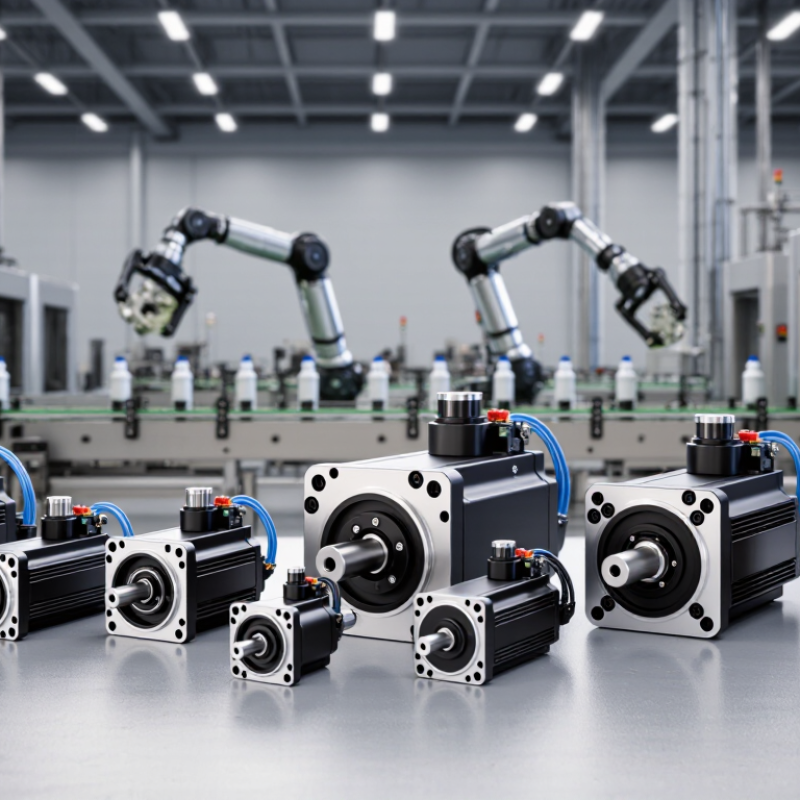
Define Servo Motors Through Closed-Loop Position, Speed, and Torque Control
A servo motor is defined by its closed-loop control, not simply by its ability to rotate. A controller sends a target position, speed, or torque, then compares that command with feedback from an encoder or another sensor. The difference becomes an error signal. The system adjusts motor output to reduce it. That matters.
In a packaging line, for example, a servo may move a cutter to a precise position, hold speed as material advances, and apply controlled torque during contact. These functions interact. A speed change can affect position, while a torque limit can prevent excessive force. During commissioning, engineers check feedback direction, tuning, and load behavior under real operating conditions. Small errors count.
The neat control diagram can mislead. Backlash, a loose coupling, or a slipping load may undermine accuracy, even when feedback is present. A sensor reports what it measures; it cannot fix poor mechanics. Operators should also watch for vibration, heat, and repeated position drift. Those clues can point to an overloaded axis or control settings that need review.
Classify Industrial Servos by 200/400 V Supply, Power, and Feedback Type
Industrial servo motors are easier to compare when grouped by supply, rated power, and feedback. Common supply classes include 200/230 V and 400/480 V, but actual ranges depend on the drive and local electrical system. Fit the supply first. A voltage mismatch can limit available torque or prevent startup.
Compare power in kilowatts alongside rated torque, peak torque, and speed. A conveyor axis may need steady torque, while a packaging arm may require brief acceleration peaks. Feedback also changes performance: incremental encoders track movement from a reference point, absolute encoders retain position data, and resolvers can suit demanding environments. The International Federation of Robotics reported 541,302 industrial robot installations worldwide in 2023 in its World Robotics 2024 report. That growth underscores why matching servo response and feedback to the machine matters; robot demand alone, however, does not determine the right motor.
Tips: Check the drive’s input-voltage range, continuous and peak current, encoder compatibility, and cable length together. Details matter. Leave thermal and load margins, too. Real machines rarely match ideal calculations perfectly.
Compare 10 Servo Families by Rated Torque, Speed, and 17–24-Bit Feedback
10 Best Servo Motors for Industrial Automation
Choosing among ten servo families means comparing more than headline torque. Rated torque determines continuous load capacity, while rated speed affects cycle time and motor sizing. Check both values at the stated voltage and operating conditions; datasheets are not always directly comparable. A 17-bit encoder provides 131,072 positions per revolution, while 24-bit feedback provides about 16.7 million. More counts do not automatically mean better accuracy. Mechanical backlash, tuning, and installation still matter.
Industrial demand makes this comparison practical. The International Federation of Robotics reported 541,302 industrial robots installed worldwide in 2023 in World Robotics 2024. Many automated axes depend on predictable motion. Compare each family’s rated torque and speed alongside feedback resolution, then verify the required torque at the actual duty cycle. A compact motor may fit the machine, yet overheat during repeated acceleration. That detail is easy to miss.
Tips: Compare continuous torque, not peak torque alone. Confirm whether encoder bit depth refers to single-turn or multi-turn feedback. Check the fine print. One limitation remains: resolution figures cannot predict real positioning performance without the drive, mechanics, and control settings.
10 Servo Motor Torque Classes for Industrial Automation
Compare representative rated torque, rated speed, and feedback resolution across common industrial servo size classes.
Feedback
17-bit
17-bit
17-bit
20-bit
20-bit
20-bit
20-bit
23-bit
23-bit
24-bit
Torque bars use the left axis; the speed line uses the right axis. Values are representative examples within commonly published industrial servo catalog ranges, not a ranking or a specification for any particular product. Actual torque, speed, and encoder combinations vary by motor and drive.
Assess Drive-System Efficiency Using IEC 61800-9-2 IE and IES Classes
For industrial automation, a servo motor’s efficiency depends on more than its nameplate rating. The motor, converter, and operating profile all affect energy use. The International Energy Agency’s 2011 report, Energy-Efficiency Policy Opportunities for Electric Motor-Driven Systems, estimated that these systems consumed about 45% of global electricity. Even modest efficiency gains can matter across many machines and operating hours.
IEC 61800-9-2 distinguishes IE classes for complete drive modules from IES classes for power drive systems. Use IE data to compare drive modules under standardized conditions; use IES data to evaluate the combined drive and motor. Compare losses at relevant speed and torque points, then consider the actual duty cycle. A servo that repeatedly accelerates a load may perform differently from one running steadily. The standard provides a useful comparison, but the label alone cannot predict plant-wide savings.
Tips: Request test data for the intended operating points, including low-speed operation and braking. Check actual losses. Also examine cable length, cooling, and regenerative energy. A tidy class rating can still hide a mismatch with the machine’s real workload. A short production-line measurement may reveal what a catalog comparison misses.
Match Servo Motors to CNC, Robotics, Packaging, and Material-Handling Duties
A useful list of ten servo motors should compare duty fit, not just peak torque. CNC axes need stable low-speed motion, fine feedback, and enough stiffness to hold a toolpath through sharp direction changes. A motor that looks powerful on paper may still struggle if the drive, encoder, or mechanical coupling is poorly matched. Check the complete axis.
Robotics asks for a different balance. Arm joints need responsive torque, manageable inertia, and thermal capacity across repeated reaches. Packaging lines often favor compact motors that accelerate quickly through frequent start-stop cycles. Heat matters. Review the actual cycle time, including pauses and product changes, rather than relying on a short demonstration. Small mistakes in duty assumptions can become real downtime.
Material-handling equipment may need steady torque at low speed, reliable braking, and room for changing loads. A conveyor moving empty totes behaves differently from one carrying dense cartons. Compare continuous and peak ratings, then verify performance with the intended drive and gearbox. Test under load. There is no perfectly clean ranking: a strong choice for a pick-and-place arm may be excessive for a simple feed axis. Real installations also expose wiring, mounting, and cooling constraints that a specification sheet cannot settle.
 +86 13630122007

 CONTACT YIYAN
 CONTACT YIYAN