+86 13630122007

- yiyanprecision@gmail.com
- Mon - Sat at 7:00AM to 9:00PM
Leave Your Message
-
CONTACT YIYAN
-
CONTACT YIYAN
-
 CONTACT YIYAN
 -
 CONTACT YIYAN
Choosing the best Precision Cnc Milling Machine is not a simple brand comparison. The right choice depends on material, tolerances, batch size, tooling, software, and operator skill. A compact three-axis machine may suit aluminum prototypes. A rigid five-axis model may perform better for complex aerospace components. More capability is not always better.
Professor Yusuf Altintas, a respected machining researcher, has emphasized, “The machine tool, cutting tool, workpiece, and process must be considered as one system.” This principle matters on the shop floor. A powerful spindle cannot correct poor fixturing. Excellent software cannot remove vibration from a weak structure. Small details decide large results.
A reliable evaluation should examine spindle speed, torque, axis travel, positioning accuracy, repeatability, control functions, coolant delivery, and service support. Look closely at the machine’s castings and guideways. Listen for abnormal vibration during a test cut. Check the surface finish on a real sample part, not only a brochure photograph. Ask how quickly replacement parts arrive.
There is no universal winner. That is easy to forget. The best Precision Cnc Milling Machine balances production goals with daily operating realities. A factory making steel molds needs different strength than a workshop producing small aluminum housings. Energy use, training time, maintenance access, and total ownership cost also deserve attention.
This guide compares leading machine types through practical criteria. It considers accuracy, productivity, flexibility, and long-term reliability. Some conclusions may remain imperfect because every workshop has different constraints. That uncertainty is useful. It encourages buyers to test machines carefully before making an expensive decision.
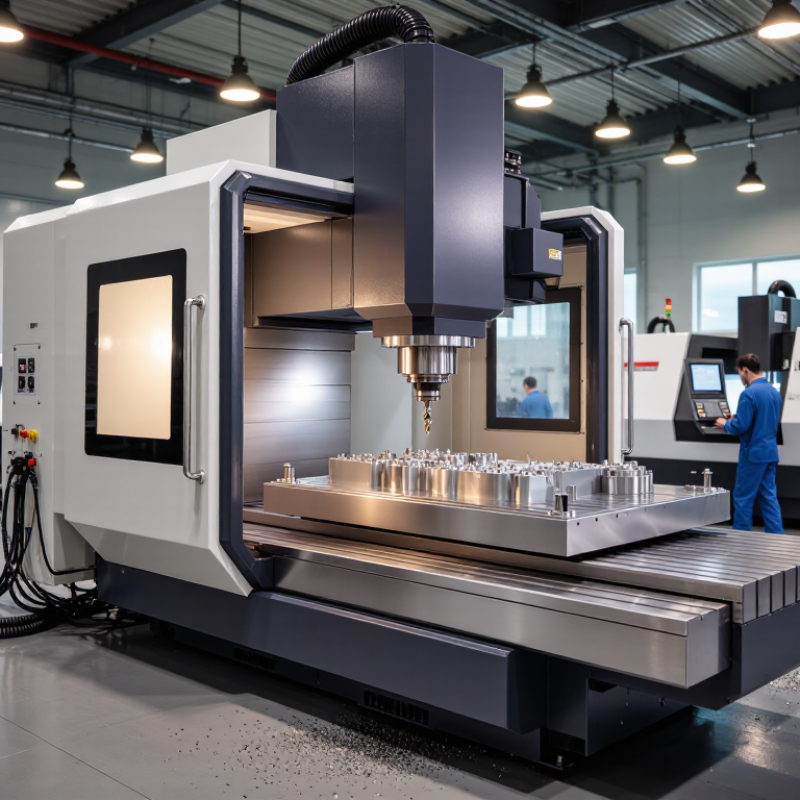
A China precision CNC milling machine is a computer-controlled cutting system for accurate metal and engineering-plastic parts. It removes material through programmed tool paths. Its core features include rigid cast structures, servo-driven axes, precision ball screws, automatic tool changing, and high-speed spindles. Precision begins with control.
According to a 2024 China Machine Tool Industry Association industry report, China produced more than 270,000 CNC machine tools in 2023. This scale supports broad supplier capabilities, but production volume does not guarantee machining accuracy. Grand View Research estimated the global CNC machine market at about USD 83.7 billion in 2023, with continued growth expected through 2030. Buyers should read these figures as market context, not proof of one machine’s performance.
In practical use, a precision model should show positioning and repeatability data measured under defined conditions. ISO 230-2 provides a recognized method for evaluating positioning accuracy. Linear scales, thermal compensation, balanced spindles, and closed-loop feedback can reduce dimensional drift during long cycles. A 0.01 mm tolerance may sound impressive. It still depends on cutting tools, material, temperature, and operator setup. My workshop experience suggests checking sample parts, inspection records, and test-cut results before purchase. A polished catalogue can hide weak thermal stability. Even a strong machine can produce poor parts when the workholding is careless.
| Core Feature | Definition | Typical Precision Milling Range | Why It Matters |
|---|---|---|---|
| Machine Configuration | The number and arrangement of controlled axes used to position the cutting tool and workpiece. | 3-axis for standard prismatic parts; 4-axis or 5-axis for multiple-sided and complex components. | More controlled axes can reduce repositioning, improve access to complex surfaces, and shorten setup time. |
| Positioning Accuracy | How closely the machine can move to a programmed coordinate. | Approximately ±0.005 to ±0.020 mm, depending on machine class, measurement method, and travel length. | Higher accuracy supports tighter dimensional tolerances and more consistent part interchangeability. |
| Repeatability | The ability to return to the same programmed position repeatedly. | Approximately ±0.003 to ±0.010 mm for precision machining centers. | Good repeatability is essential for batch production and stable quality between production cycles. |
| Spindle Speed | The rotational speed of the cutting tool spindle, measured in revolutions per minute. | About 6,000–12,000 rpm for general milling; 15,000–30,000 rpm for high-speed aluminum and finishing work. | The correct speed improves cutting efficiency, surface finish, and tool life for different materials. |
| Spindle Power | The available motor power for removing material during cutting. | Approximately 5.5–15 kW for general precision machining; higher power is used for heavy-duty cutting. | Adequate power prevents excessive load, vibration, and reduced productivity during roughing operations. |
| Working Envelope | The maximum usable X, Y, and Z travel available for the workpiece and cutting tool. | Common compact-to-medium ranges are approximately 500–1,000 mm in X, 350–600 mm in Y, and 400–600 mm in Z. | The travel must accommodate the part, fixtures, tool length, and required clearance. |
| Table Load Capacity | The maximum supported weight of the workpiece, fixture, and tooling. | Typically about 300–1,000 kg for small and medium vertical machining centers. | Correct load capacity helps maintain machine stability, accuracy, and safe operation. |
| Tool Changer Capacity | The number of cutting tools that can be stored and changed automatically. | Approximately 12–30 tools for common production configurations; larger magazines are available for complex work. | A larger tool magazine reduces manual intervention and supports more operations in one setup. |
| Linear Rapid Traverse | The maximum non-cutting travel speed of the machine axes. | Approximately 20–40 m/min on many modern vertical machining centers. | Higher rapid speed can reduce idle motion and improve cycle time when properly controlled. |
| Machine Structure | The frame, column, base, guideways, and support elements that resist cutting forces. | Common precision designs use cast structures, linear or box guideways, and thermally stable assemblies. | A rigid and stable structure reduces vibration, improves surface finish, and preserves accuracy. |
| Control System Functions | The software and hardware used to interpret programs and coordinate machine movement. | Typical functions include 3D interpolation, tool compensation, probing support, look-ahead, and high-speed machining control. | Advanced controls improve contour accuracy, programming flexibility, and production monitoring. |
| Material Compatibility | The range of materials that can be machined with suitable tools, speeds, feeds, and coolant. | Aluminum, steel, stainless steel, brass, plastics, and selected titanium or hardened materials. | Material requirements determine spindle torque, machine rigidity, tooling, coolant, and cutting strategy. |
| Best Application Match | The production situation in which a machine provides the best balance of accuracy, capacity, speed, and cost. | 3-axis: plates and housings; 4-axis: indexed multi-side parts; 5-axis: aerospace, medical, mold, and complex components. | The best machine is selected according to part geometry, tolerance, material, batch size, and available floor space. |
Note: The specifications above are typical industry ranges for precision CNC milling machines. Actual performance depends on machine size, structural design, calibration, tooling, workholding, material, operating conditions, and measurement standards.