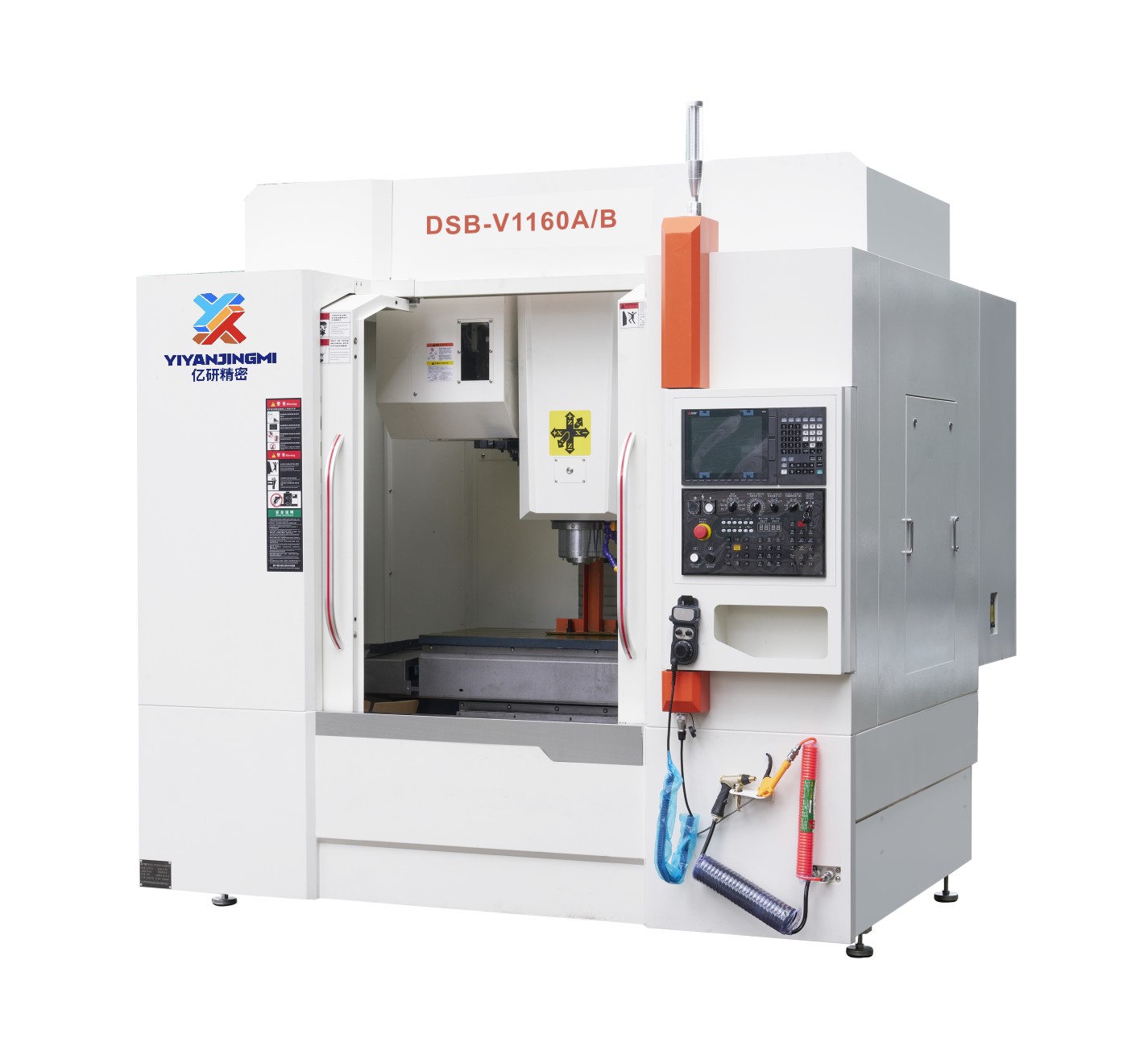
Advantages of Vertical Machining Centers
As a commonly used automated equipment in the field of mechanical processing, vertical machining centers demonstrate significant advantages in various parts processing scenarios due to their unique structural design and functional characteristics. The specific advantages can be analyzed from the following dimensions:
1. Compact Structure and High Space Utilization
The spindle axis of a vertical machining center is vertically distributed with the worktable surface, and the overall machine body is designed to be compact, without occupying excessive workshop space. Compared with equipment such as horizontal machining centers, its floor space can usually be reduced by 30%-50%, making it particularly suitable for small and medium-sized processing plants or production scenarios with limited workshop space. At the same time, the compact structure also facilitates the layout planning of the equipment in the workshop. The placement position can be flexibly adjusted according to the production process, reducing the difficulty of workshop space planning and improving the utilization rate of the overall production area.
2. Convenient Operation and Low Maintenance Costs
From the operational perspective, the worktable of a vertical machining center is in a horizontal state, allowing operators to intuitively observe the workpiece clamping, processing process, and tool operation. This makes it easy to promptly detect abnormal issues during the processing, such as workpiece loosening and tool wear, thereby reducing the rate of operational errors. In the workpiece clamping process, the horizontal worktable does not require complex fixture adaptation. Conventional fixtures can meet the fixing needs of most workpieces, simplifying the clamping process and shortening the auxiliary processing time.
In terms of maintenance, the core components of vertical machining centers (such as spindles, guideways, and ball screws) have a relatively exposed layout and simple structure, enabling maintenance personnel to perform inspection, maintenance, and repair operations more conveniently. For example, daily maintenance tasks such as guideway cleaning, lubrication, and ball screw wear detection have low operational difficulty and short time consumption, which can effectively reduce the equipment downtime for maintenance. In addition, its components have strong versatility, and the replacement cost is relatively low. The long-term maintenance cost is significantly lower than that of other types of machining centers.
3. Stable Machining Precision and Wide Adaptation Range
Vertical machining centers are equipped with high-precision linear guideways, ball screws, and servo drive systems, which can achieve precise control of the X, Y, and Z-axis movements. The positioning accuracy can reach ±0.005mm/300mm, and the repeat positioning accuracy is stably within ±0.005mm (compatible with the parameters of the 2203B model mentioned earlier). They can meet the processing needs of precision parts, such as mold cavities, precision gears, and aerospace components.
In terms of processing adaptability, vertical machining centers can be compatible with various processing procedures such as milling, drilling, boring, tapping, and reaming. They can complete multiple processing processes of a workpiece at one time, reducing the number of transfers of the workpiece between different equipment, lowering the positioning error caused by transfer, and improving the overall machining precision of the workpiece. At the same time, their worktables can bear workpieces of a certain weight (for example, the maximum load capacity of the worktable of the 2203B model mentioned earlier can reach 4T). They can not only process small precision parts but also meet the processing needs of medium and large workpieces. The adaptation range covers multiple industries such as mechanical manufacturing, auto parts, electronic equipment, and mold processing.
4. High Production Efficiency and Low Energy Consumption
The spindle speed of vertical machining centers is usually relatively high (the spindle speed of conventional models can reach 6000 r.p.m, and that of special models can be up to 8000 r.p.m). Combined with a high-speed feed system (for example, the rapid traverse speed of the X/Y axis can reach 12 m/min, and that of the Z axis can reach 10 m/min), they can greatly increase the cutting speed and shorten the processing cycle of a single workpiece. In addition, some vertical machining centers are equipped with an automatic tool change system (the tool magazine capacity can be configured according to requirements), which can realize automatic tool change, reduce the manual tool change time, and further improve the continuous production efficiency. They are particularly suitable for mass production scenarios.
In terms of energy consumption, the motor power configuration of vertical machining centers is reasonable (for example, the spindle motor power is mostly around 22KW), and the motor output power can be automatically adjusted according to the cutting needs during the processing, avoiding energy waste. Compared with horizontal machining centers or gantry machining centers with the same processing capacity, their energy consumption per unit time can usually be reduced by 15%-20%, which can help enterprises save considerable energy costs in long-term use.
5. Outstanding Cost-Effectiveness and Fast Investment Return
From the perspective of equipment purchase cost, under the same machining precision and functional configuration, the price of vertical machining centers is usually lower than that of high-end equipment such as horizontal machining centers and gantry machining centers, making them suitable for the budget needs of small and medium-sized enterprises or start-ups. At the same time, their subsequent installation and commissioning costs are low, and the equipment can be put into use in a short period, quickly entering the production state.
In terms of investment return, due to the high production efficiency, low maintenance cost, and wide range of applicable workpiece types of vertical machining centers, enterprises can quickly recover the equipment investment cost by undertaking various processing orders. According to industry data statistics, the investment payback period of conventional vertical machining centers is usually 1-2 years, which is significantly shorter than that of other types of precision processing equipment, bringing faster economic benefits to enterprises.
 +86 13630122007