How to Choose the Right Servo Motor for Your Applications?
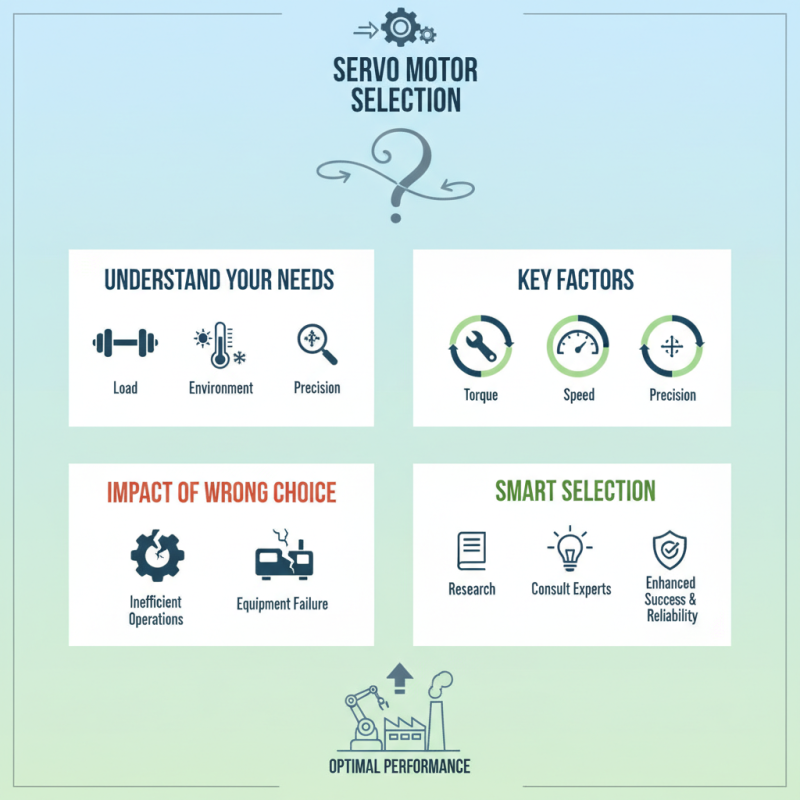
Choosing the right servo motor for your applications can be challenging. Servo motors play a crucial role in automation and robotics. Their performance can make or break a project. Many factors influence your choice, including torque, speed, and precision.
Understanding your specific needs is vital. For instance, consider the load the motor will drive. You must also evaluate the environmental conditions. Some motors may not perform well in extreme temperatures. Precision is another essential factor. Not all applications require the same level of accuracy.
Reflecting on these factors can lead to improvements in your choice. A miscalculation can result in inefficient operations or equipment failure. Research is essential. Consulting experts can provide insights that may not be evident at first glance. Ultimately, the right servo motor can enhance your project's success and reliability.
Understanding Servo Motor Types: AC vs. DC and Their Applications
When selecting a servo motor, understanding the differences between AC and DC types is pivotal. AC servo motors are known for their high efficiency and are used widely in industrial applications. According to industry reports, AC motors account for approximately 60% of the global servo motor market. They excel in environments requiring continuous operation and high precision, such as CNC machinery and robotics. Their ability to deliver high torque at varying speeds makes them ideal for these applications.
On the other hand, DC servo motors typically offer better control over low-speed operation. They are often favored in applications needing quick responsiveness. A recent survey indicated that DC motors are prevalent in consumer electronics and automotive systems, where agile performance can significantly impact user experience. However, some users encounter challenges with heat generation and maintenance. These factors must be considered when assessing the suitability of a DC motor for a specific project.
Both AC and DC servo motors have unique advantages and limitations. You might find the perfect fit for your application only after careful evaluation. Data shows that a thoughtful selection process can lead to improved performance and efficiency in your systems. Reflecting on your specific needs and the operational environment will guide you in making the right choice.
Key Specifications to Consider: Torque, Speed, and Precision Requirements
When selecting a servo motor, focusing on torque is crucial. Torque determines how much force the motor can exert. It's essential to match the motor's torque specifications with your application's needs. For example, robotic arms require high torque to lift and manipulate objects. Conversely, less demanding tasks might need minimal torque. Ensuring that the motor provides adequate torque prevents stalling or failure.
Speed is another vital specification. Different applications demand various speed levels. A conveyor belt requires consistent, steady speed for efficient operation. Meanwhile, a CNC machine may need varying speeds for precision cutting. Understanding the speed requirements can significantly enhance performance. It's worth noting that exceeding speed ratings can lead to overheating and damage.
Precision is often the final consideration. High-precision applications, like surgical robots, need motors that can deliver exact movements. A motor's feedback system plays a key role here. In less critical applications, precision might be less stringent, but it’s important to assess whether the motor can meet the required accuracy. Balancing these three specifications—torque, speed, and precision—ensures optimal performance of your servo motor in its intended application.
Evaluating Control Systems: Open-Loop vs. Closed-Loop Architectures
When selecting a servo motor, understanding control systems is crucial. The two primary architectures are open-loop and closed-loop. Open-loop systems function without feedback. They offer simplicity and lower costs, making them suitable for straightforward applications. However, they lack precision. In fact, a report by the International Society of Automation shows that 30% of manufacturing errors stem from using open-loop systems in complex processes.
Closed-loop systems, on the other hand, incorporate feedback mechanisms. This enables them to adjust in real-time, ensuring higher accuracy. According to a study published in the Journal of Robotics and Automation, closed-loop systems can improve the overall performance by 50% in dynamic environments. They adapt quickly to changes, which is vital in robotics and CNC machining. However, these systems often entail higher complexity and cost.
Choosing between these options depends on specific application needs. If reliability and precision are paramount, closed-loop systems may be worth the investment. Yet, for simpler tasks, an open-loop system can suffice. Always assess the unique demands of your project. Balancing cost with performance metrics will lead to the right decision.
How to Choose the Right Servo Motor for Your Applications? - Evaluating Control Systems: Open-Loop vs. Closed-Loop Architectures
| Application Type |
Control System |
Torque (Nm) |
Speed (RPM) |
Feedback Type |
| Robotics |
Closed-Loop |
10 |
3000 |
Resolver |
| CNC Machines |
Closed-Loop |
15 |
2000 |
Encoder |
| Assembly Line |
Open-Loop |
20 |
1500 |
None |
| Printing Machines |
Closed-Loop |
5 |
2500 |
Hall Effect |
| Automated Guided Vehicles |
Closed-Loop |
30 |
1800 |
Magnetic |
Choosing the Right Size and Form Factor for Your Servo Motor Needs
When selecting a servo motor, size and form factor are crucial. These factors influence performance capabilities, power consumption, and integration into existing systems. Evaluating the space available in your project is essential. If the area is tight, a compact servo motor can save space while providing adequate torque.
The weight of the motor should also be a consideration. Lighter motors are typically easier to handle and install. However, lighter weight often means less torque, which might not meet your project's demands. Finding the right balance between size and power is key.
Don't overlook the mounting options either. Your application may require specific geometries for proper integration. Check how the motor will be attached to the machine. You might face challenges if the motor doesn't fit perfectly. Sometimes, you need to revisit your design to accommodate the chosen servo motor effectively. This step is important for ensuring long-term reliability in your application.
Budget Considerations: Cost-Effectiveness vs. Performance Trade-offs
When selecting a servo motor, budget considerations play a crucial role. Balancing cost-effectiveness and performance is key. Often, cheaper options sacrifice reliability and longevity. A low-cost servo may perform adequately at first, but could fail under high demand, resulting in increased costs down the line. Consider long-term expenses instead of just the initial purchase price.
Tips for budget-conscious buyers: evaluate your specific application requirements. Determine the necessary torque, speed, and precision needed. A motor that exceeds these specifications may be wasteful. Look for products with dependable warranties to ensure reliability. Invest in quality over mere affordability to avoid future setbacks.
Choosing the right servo motor can be a complex task. Unexpected issues may arise from overlooking the importance of performance requirements. Sometimes, the temptation to cut costs leads to poor choices. Address these trade-offs with a thorough analysis of your operational needs. This approach ensures that your investment will deliver value and performance, ultimately saving money in the long run.
Cost-Effectiveness vs. Performance Trade-offs in Servo Motor Selection
 +86 13630122007

 CONTACT YIYAN
 CONTACT YIYAN