How to Choose the Right Servo Motor for Your Project?
Choosing the right servo motor for your project can seem daunting. Industry expert Dr. Emily Chen states, “A servo motor is more than just a component; it shapes your project’s success.” Her insights reflect the critical role servo motors play in various applications.
When selecting a servo motor, consider your project requirements. Think about torque, speed, and control precision. Each parameter influences the motor's performance. Choosing incorrectly could lead to insufficient power or overcomplicated control systems.
It’s crucial to reflect on common pitfalls. Many enthusiasts focus solely on specifications. They often overlook factors like compatibility and feedback systems. A thoughtful approach can prevent costly mistakes. Understanding servo motor types and their unique features is essential for optimal performance. Balancing these details will significantly enhance your project's outcome.
Understanding the Basics of Servo Motors
Understanding the basics of servo motors is crucial for any project involving motion control. A servo motor is a specialized type of motor that provides precise control of angular position. They are widely used in robotics, automation, and other engineering applications. When selecting a servo motor, consider the torque requirements, speed, and overall efficiency. Each project may demand different specifications based on its unique challenges.
Tips: Identify your project's weight and load requirements. High torque may lead to better performance, but it can also increase costs. Ensure the servo can handle the specified load comfortably.
Another important aspect is understanding feedback systems. Servo motors can be open-loop or closed-loop. Closed-loop systems offer better accuracy and responsiveness. However, they are often more complex and expensive. Seek clarity in your requirements to determine which is better for your application.
Tips: Take your time in researching different features. A common mistake is rushing into a decision without fully understanding the options. Assessing the long-term needs of your project can save you from regrettable choices.
Servo Motor Selection: Torque vs Speed
Identifying Project Requirements for Servo Motors
When selecting a servo motor, understanding project requirements is crucial. Start by identifying the load that the motor needs to handle. This can be the weight of an object or the amount of force needed to move it. Calculate these factors accurately. A mismatch here can lead to underperformance or even motor failure.
Consider the type of control required in your project. Do you need precise positioning or simple speed control? Some projects demand high accuracy, while others may allow for more flexibility. Reflect on your desired range of motion as well. Different servo motors provide different angles of rotation. A motor that does not meet these requirements may cause frustration during testing.
It’s vital to think about power supply specifications as well. Check the voltage and current requirements of your servo motor. Ensure it matches your available power source. Moreover, consider integration with other components. Compatibility can be a challenging aspect. Identify potential issues early on to avoid complications. All these factors matter significantly. Missing one can lead to inefficiency or project delays.
Evaluating Different Types of Servo Motors
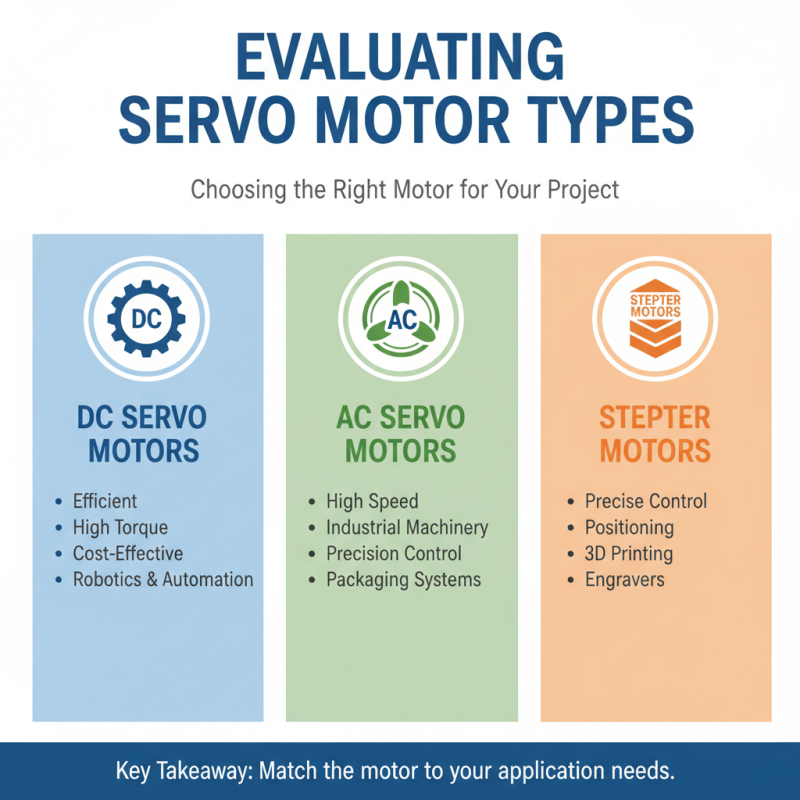
When choosing a servo motor for your project, understanding the types available is crucial. Servo motors can be classified into three main types: DC, AC, and stepper motors. Each type has unique characteristics suitable for different applications. DC servo motors are efficient and provide good torque. AC servo motors excel in high-speed applications. Stepper motors offer precise control, ideal for 3D printing.
Tips: Consider your application’s requirements carefully. Load, speed, and precision are key factors. Match the motor type to your project needs. For example, if precision is vital, stepper motors might be your best choice. However, they could be less efficient at higher speeds.
Another factor to reflect on is the control system you plan to use. Some servo motors work well with simple, analog controls, while others may require complex digital systems. Make sure to evaluate the compatibility of your motor and control system. An unsuitable combination may hinder performance.
Tips: Assess the environment where the motor will operate. High temperatures or humidity can impact motor reliability. Ensure that you select a motor designed for the conditions it will face. It's worth remembering that sometimes, overlooked details can lead to issues down the line.
Comparing Specifications and Features of Servo Motors
When selecting a servo motor, understanding specifications and features is crucial. Key factors include torque, speed, and power rating. Torque determines how much weight the motor can handle.
Higher torque is essential for heavier applications. On the other hand, speed can affect how quickly your project operates. Look for motors with optimal RPM that match your requirements.
Moreover, consider feedback types. Servo motors come with various feedback systems like analog, digital, or absolute encoders. Each has its advantages, affecting precision and control. For example, absolute encoders provide exact position data, which can be vital for automated tasks. Review your project’s needs carefully to select the right feedback mechanism.
Some may overlook the importance of size and weight. A large motor might offer high performance but could complicate the design. Think about the entire system when making a choice. Reflecting on these factors can help avoid costly mistakes later. Understanding these specifications can ultimately save time and enhance project efficiency.
Making the Final Selection: Factors to Consider
When making the final selection of a servo motor, several factors come into play. Understanding your project's specific needs is crucial. Consider the required torque and speed for your application. Do you need high precision or more torque? This choice will influence the motor's specifications significantly.
Another important aspect is voltage and current ratings. Ensure that the servo motor matches your power supply capabilities. If the ratings don’t align, you may encounter performance issues. Testing different motor models can reveal their strengths and potential flaws.
Think about the environment where the servo will operate. Will it face humidity or dust? Choose a motor with appropriate sealing or protection. It is essential to weigh all these factors carefully. A sigh can sometimes signal doubt; reflect on each aspect. Balancing these considerations will guide you to a suitable choice for your project.
 +86 13630122007

 CONTACT YIYAN
 CONTACT YIYAN