How to Choose a Servo Motor for Your Project?
Choosing the right Servo Motor for your project is crucial. The global servo motor market is projected to grow significantly. According to a report by Allied Market Research, the industry is expected to reach $9.7 billion by 2027. This growth reflects increasing automation and robotics demand across various sectors.
Experts emphasize the importance of making an informed choice. Dr. Emma Hansford, a renowned servo motor specialist, once stated, "Understanding your project's requirements is key to selecting the right servo motor." Selecting a servo motor is not just about efficiency; it also affects precision and overall performance.
Considerations include torque, speed, and application type. Each factor influences the motor's function in unique ways. Some projects may require high performance, while others prioritize cost-effectiveness. Potential missteps in selecting specifications can lead to project delays or increased costs. Take time to research, consult with professionals, and weigh your options carefully. This approach ensures you choose a reliable servo motor that meets your project's needs.

Understanding the Basics of Servo Motors and Their Applications
When selecting a servo motor for your project, understanding its basics is vital. Servo motors are electromechanical devices. They control angular or linear position, velocity, and acceleration. A typical servo system includes a motor and a feedback sensor. These components work together to achieve precise control over movement.
Applications of servo motors span various industries. Robotics, automation, and aerospace utilize servo motors frequently. In robotics, they provide accurate movement for limbs or wheels. Automation systems employ servo motors in assembly lines for precise positioning. Aerospace uses them for controlling flaps and other critical components. Each application demands a different level of torque and speed.
Choosing the right servo motor can feel overwhelming. Different projects require different specifications. Standard motors may not provide the necessary precision. Additionally, environmental factors like temperature can affect performance. Reflecting on these considerations is crucial for project success. Engaging with experienced professionals or forums can help clarify uncertainties.
Identifying Your Project Requirements for Servo Motor Selection
When selecting a servo motor, understanding your project requirements is crucial. Start by determining the type of movement you need. Will your project rotate something, or does it require linear motion? Identify the load the motor needs to handle. This includes weight and any friction that may be involved. Knowing these specifications helps narrow down the choices.
Next, consider the precision required for your application. Some projects might need only basic functionality. Others might demand high accuracy. Evaluate the feedback mechanism needed. Some servo motors offer closed-loop control systems for precise positioning. Others, known as open-loop systems, may suffice for simpler tasks. It’s important to match the motor's capabilities with your project demands.
Evaluate power requirements as well. What voltage and current can your power supply provide? Think about the environment too. Will the servo face heat, dust, or moisture? The motor’s rating should reflect these conditions. Reflecting on the alternatives is also key. Sometimes a different type of actuator might better suit your needs. Analyzing these elements ensures you make an informed decision tailored to your specific project.
Evaluating Different Types of Servo Motors for Your Needs
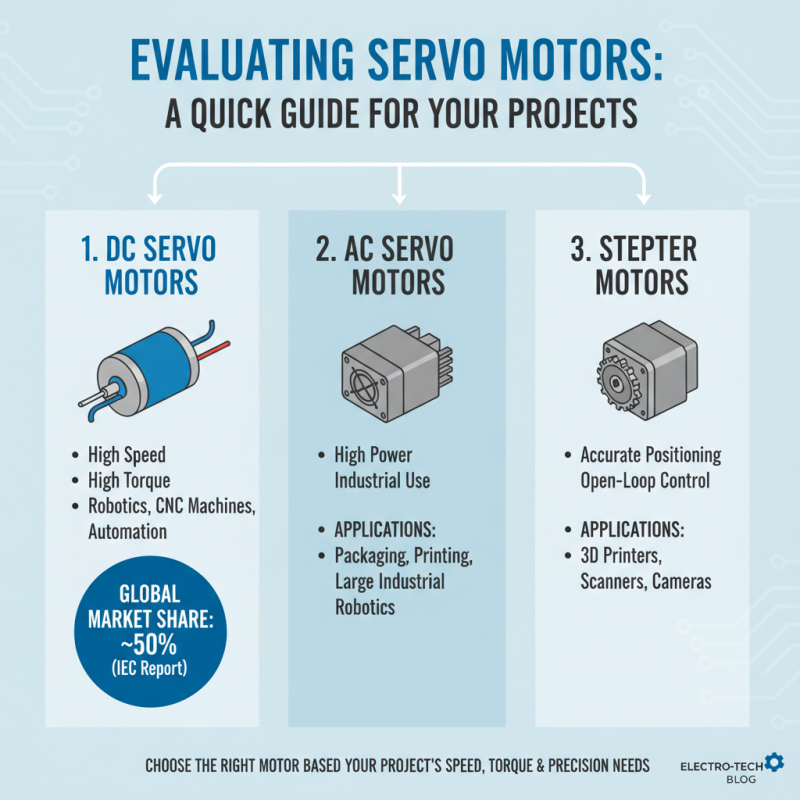
When evaluating the different types of servo motors for your project, various factors come into play. Servo motors can be classified into three main categories: DC, AC, and stepper motors. Each type has unique characteristics that can make it suitable for specific applications. DC servo motors are well-suited for applications requiring high-speed and high-torque capabilities. The International Electrotechnical Commission reported that DC motors account for nearly 50% of the global servo market, indicating their popularity in automation.
AC servo motors are increasingly favored for industrial use. They offer high efficiency and longevity, making them ideal for precision applications. Research from the Electrical and Electronics Engineers reveals that AC servos tend to have better performance in dynamic environments. However, they can be more complex to control than their DC counterparts, raising the need for expertise in implementation.
Stepper motors provide an alternative for projects needing precise movements. They excel in open-loop control systems and are often easier to program. According to industry studies, stepper motors hold approximately 30% of the market share within smaller applications. A common pitfall is underestimating the potential heat generation during extended use. Evaluating your application’s requirements is crucial to prevent such oversights. Don't forget to assess the control systems you plan to implement alongside the motor type chosen.
Key Specifications to Consider When Choosing a Servo Motor
When selecting a servo motor, key specifications are essential for optimal performance. Torque, for example, is crucial. It defines how much force the motor can exert. High torque is necessary for heavy loads, while lower torque suffices for lighter tasks. Understanding the torque requirement of your application ensures better efficiency.
Speed is another important specification. Each project may need a different speed range. Some tasks may require quick movements, while others prioritize precision over speed. Pay attention to the motor’s RPM ratings. Additionally, consider the feedback mechanism. Closed-loop systems provide better control. They are ideal for applications requiring accuracy.
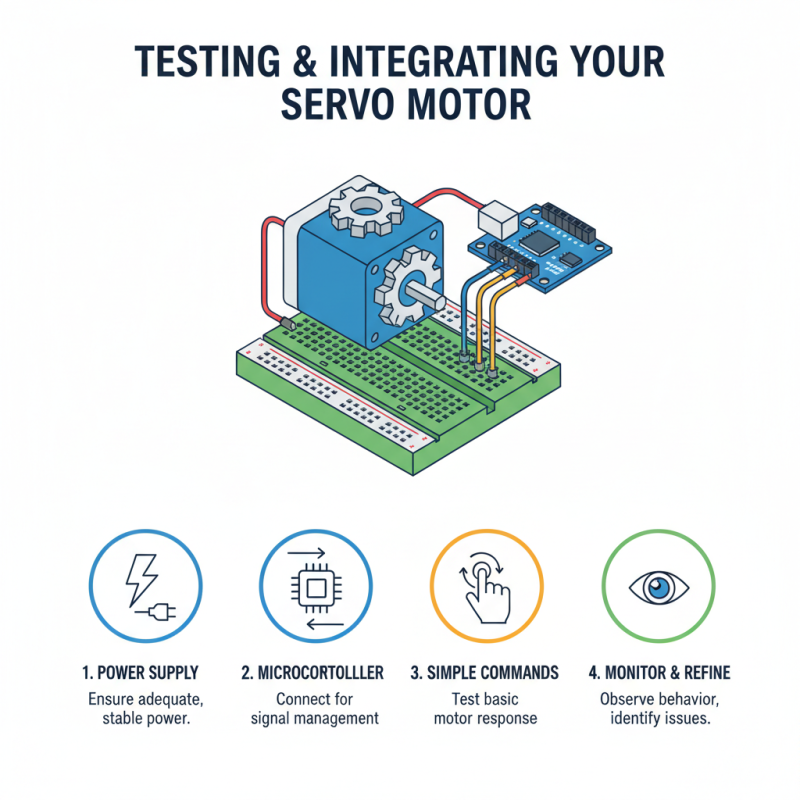
Voltage ratings also play a role in your choice. Ensure compatibility with your power supply. An underpowered motor may lead to performance issues. Overvoltage could damage the motor. Always check the manufacturer’s guidelines. Lastly, look into the motor’s dimensions and weight. Space constraints may limit your options. A compact design can save valuable space in your project, but ensure it meets other performance criteria.
How to Choose a Servo Motor for Your Project? - Key Specifications to Consider When Choosing a Servo Motor
| Specification |
Description |
Typical Value |
| Torque |
The rotational force of the motor |
2.5 kg·cm |
| Speed |
The rate of rotation |
0.14 sec/60 degrees |
| Voltage |
Operating voltage range |
4.8 - 6.0 V |
| Dimensions |
Physical size of the motor |
40 x 20 x 38 mm |
| Weight |
The mass of the motor |
50 g |
| Control Type |
How the motor is operated |
PWM Signal |
| Feedback Type |
Type of feedback used for control |
Position Feedback |
 +86 13630122007

 CONTACT YIYAN
 CONTACT YIYAN